
TseringJune 12, 2025
User-Generated Content vs Traditional Advertising: Which Wins for Your Brand?
TL:DR
ou scroll past dozens of polished ads every day but pause for one authentic video of a real person sharing their experience. Why?
With so much polished advertising competing for attention, authentic content stands out. In fact:
- UGC-based ads get 4x higher click-through rates and a 50% drop in cost-per-click compared to average ads.
- 79% of people say customer-generated content highly impacts their purchasing decisions.
- Brands see a 20% increase in engagement when they share UGC.
User-Generated Content vs Traditional Advertising: Which Wins for Your Brand?
Every marketing budget runs into the same question sooner or later: do you pay to broadcast a polished message, or do you put your product in the hands of real people and let them talk about it? That is the heart of the user-generated content vs traditional advertising debate. The honest answer is that each one wins in different situations.
This guide compares the two on the things that actually affect your budget (trust, cost, speed, measurement, and control) and gives you a simple way to decide where your next dollar should go.
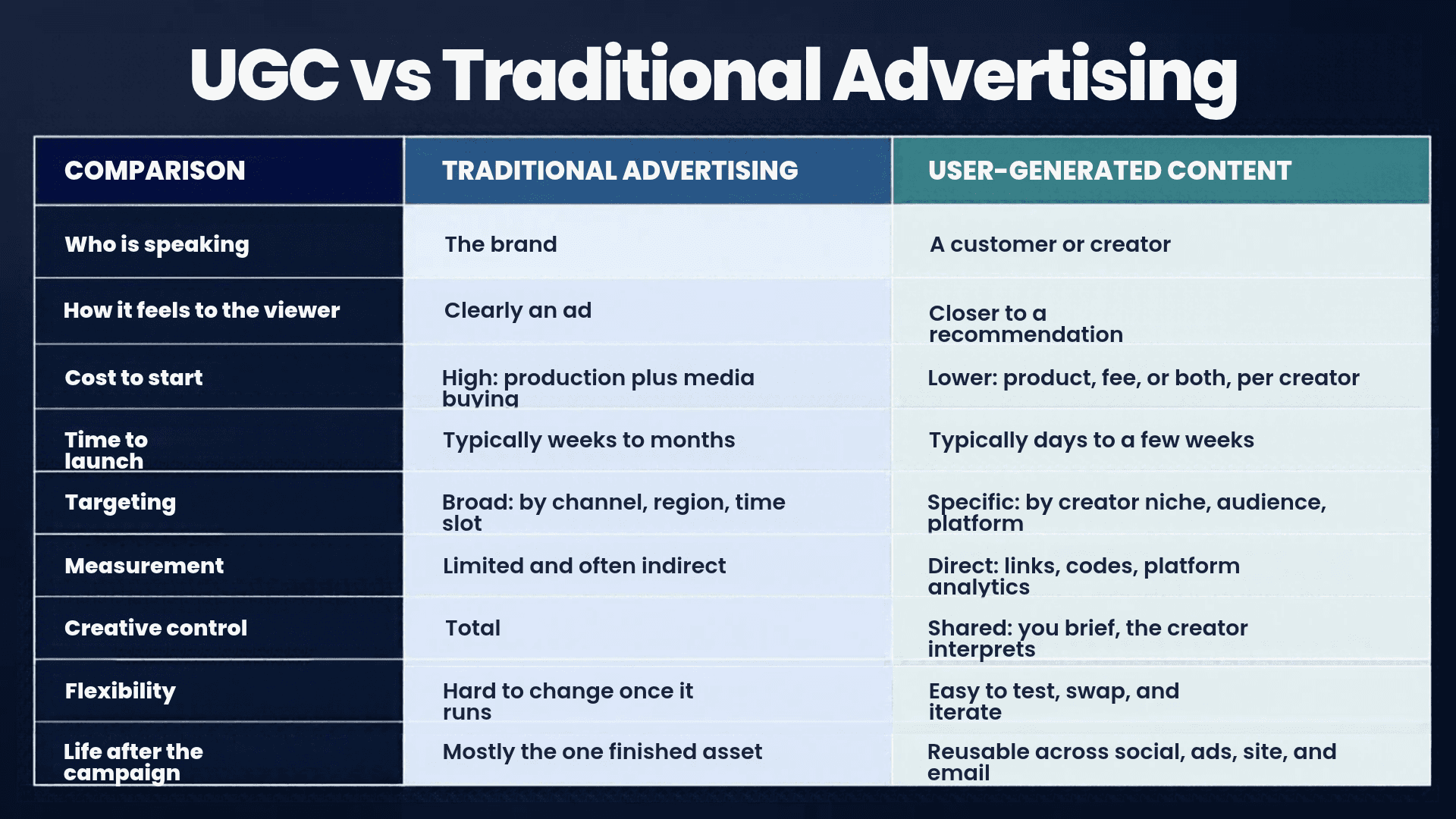
Quick answer: User-generated content (UGC) usually wins on trust, cost, speed, and testability. Traditional advertising wins on instant mass reach and local presence. Most brands, especially small and mid-sized ones, should lead with UGC and add traditional channels only when they need scale a creator-led approach can't deliver quickly.
What Counts as Traditional Advertising?
Traditional advertising is paid media that runs through offline, one-to-many channels: TV and radio spots, newspapers and magazines, billboards and transit ads, and direct mail. The brand writes the message, buys the placement, and the audience receives it whether or not they were looking for it.
Its strengths are real. You choose the exact message, you control where it appears, and a well-placed campaign can put your name in front of a very large audience at once. Its weak spots are cost, slow production, and the fact that you rarely learn which part of the campaign actually worked.
What Counts as User-Generated Content?
User-generated content is any content about your brand that is made by someone other than your brand: customer reviews, photos, unboxing and "how I use it" videos, testimonials, and creator videos produced for your product. Some of it happens on its own. Some of it you commission, which is how most brands scale it.
It's worth separating UGC from influencer marketing. Influencer campaigns pay for a creator's reach, meaning their audience and their channel. UGC is about the content itself, which you can then run on your own channels, product pages, ads, and emails. Many brands use both, and creator campaigns can deliver either.
Where UGC Beats Traditional Advertising
1. It answers the question shoppers actually have
Before buying, most people want to know one thing: will this work for someone like me? A billboard can't answer that. A stranger who has used the product can. That's why customer reviews and creator videos tend to carry weight at the moment of decision, and why UGC reviews have become a standard part of product pages. If you sell on marketplaces, see why UGC reviews are becoming essential for ecommerce.
2. You can test before you commit
A TV or print campaign is one large bet. By the time you know whether the message landed, the budget is spent. With UGC you can brief several creators, try different hooks and angles, and put more money behind the ones that perform. Smaller bets, faster feedback, less waste.
3. You can see what's working
Creator links, discount codes, and platform analytics make it far easier to connect content to clicks and sales than a radio spot or a magazine page ever could. That makes it easier to defend the budget, and easier to improve it next month.
4. The content keeps working
A finished TV spot is mostly one asset. A batch of creator videos can fuel your social feed, your ads, your product pages, and your email flows. Keeping approved content in a content library means each campaign feeds the next one, which is one reason UGC keeps outperforming other formats on social media.
5. It keeps working after the sale
UGC isn't only an acquisition tool. Customer stories, how-to videos, and community content help people get more from what they bought and come back for more. We cover that in UGC for customer retention marketing.
Where Traditional Advertising Still Wins
UGC isn't the right answer to everything. Traditional channels still make sense when:
- You need mass reach quickly. A national launch, a major event, or a seasonal push can call for broad exposure that a creator-led approach builds more gradually.
- Your customers are local and your area is small. Radio, print, and outdoor ads reach everyone in a defined area, including people who never open the apps where your creators post.
- You're building long-term brand memory. Repeated, consistent exposure can make a brand feel familiar in a way scattered social content doesn't.
- You need total control of the message. Regulated categories and tightly managed brands sometimes can't leave wording to a creator.
- Part of your audience simply isn't scrolling. Some groups are easier to reach offline than online.
If you're a local business weighing this up, see why local businesses lose customers before they ever walk in.
The Real Risks of UGC (and How to Manage Them)
UGC has trade-offs, and it's better to plan for them than to be surprised.
- Less control over the message. A creator interprets your brief in their own voice. Fix: write a tight brief with must-say points, no-go claims, and examples of what good looks like.
- Uneven quality. Not every video will match your standards. Fix: choose creators whose past work fits your brand, and review content before it goes live.
- Rights and permissions. You need clear permission to reuse content in ads and on your site. Fix: agree on usage rights up front, in writing.
- Disclosure. Paid or gifted content should be labeled according to your market's and platform's rules. Fix: put disclosure requirements in the brief.
- Time and admin. Briefing, sourcing, following up, reviewing, and paying creators adds up. Fix: use a platform that handles matching, approvals, and payouts, so the process doesn't become a second job.
How to Decide: Four Questions
- Who are you trying to reach, and where are they? If they're on social, UGC meets them there. If they're in a specific neighborhood or an older, offline-leaning group, traditional channels earn a place.
- What job does this campaign do? Awareness at scale leans traditional. Consideration and conversion lean UGC.
- How fast do you need to launch, and how much can you risk on one idea? Short timelines and tight budgets favor UGC.
- Can you measure the result? If you can't tell what worked, you can't improve it. UGC makes that easier.
A Practical Hybrid: Use UGC as Your Testing Lab
You don't have to pick a side. A smart way to combine them: run UGC first, watch which hooks, claims, and formats perform, and then use those winners as the creative direction for broader placements. You're spending traditional-media money on messages that have already proven themselves, instead of guessing.
How to Start a UGC Program Without Overloading Your Team
- Pick one goal. Product launch, social proof for a hero product, or fresh ad creative. One goal keeps the brief clear.
- Write a short, specific brief. What the product is, what to show, what to avoid, and how long the video should be.
- Choose creators who fit. Match on niche, audience, and style rather than follower count alone. Creator campaigns on Veel handle matching, invitations, and tracking.
- Set usage rights and approval steps. Review content before it goes live and before payment is released.
- Handle payment simply. Global creator payouts mean working with creators in different countries doesn't add more admin.
- Reuse everything. Put approved content in your library and turn it into posts, ads, and product-page assets.
- Keep the rhythm going. UGC works best when it feeds a steady posting schedule. If time is the bottleneck, read why social media takes so much time for small businesses and meet Sis, Veel's AI social media manager.
If you're a small team, Veel is built for small businesses. And if you're not sure where your social presence stands today, start with a free social media audit.
Frequently Asked Questions
Is UGC more effective than traditional advertising?
It depends on the goal. UGC tends to be stronger for trust, consideration, and conversion, and it's easier to test and measure. Traditional advertising tends to be stronger for fast mass reach and local presence. Many brands get the best results by combining them.
Is UGC cheaper than traditional advertising?
Usually, to start. Traditional campaigns require production and paid media placement up front, while UGC can begin with a product, a creator fee, or both. Total cost still depends on how many creators you work with and how you reuse the content.
Can UGC replace traditional advertising entirely?
For many online-first and small brands, yes. For brands that need broad offline reach, serve a local area, or sell to audiences that are harder to reach online, a mix usually works better.
What is the difference between UGC and influencer marketing?
Influencer marketing pays for a creator's reach, meaning their audience and channel. UGC focuses on the content itself, which your brand can run on its own channels, ads, and product pages. The two overlap, and many campaigns use both.
How do I get UGC for my brand?
You can encourage customers to leave reviews and share photos, run branded hashtag or contest campaigns, or commission creators directly. A platform like Veel handles matching, briefs, approvals, and payments in one place.
Ready to try it? Start free on Veel or see pricing.